How to Find a GPS Tracker on Your Car (UK Edition)
December 9, 2025 - Reading time: 25 minutes
Updated on: December 12, 2025
Suspecting that your car might have a hidden GPS tracker is an unsettling feeling. In an age of affordable spy gadgets and easy-to-conceal devices, finding a covert tracker on a vehicle has become a modern concern. As a professional private investigation agency in the UK, we have seen first-hand how GPS tracking devices are used - and how carefully they can be hidden. In this UK edition guide, we’ll explain how to find a GPS tracker on your car, what to look for, and the steps you can take to protect your privacy. While we’ll keep the language accessible for everyone, we’ll also use a few technical terms (GSM, RF detectors, magnet mounts, etc.) to give you the full picture and reinforce our expertise.
At Private Investigators UK, we offer vehicle debugging (finding and removing surveillance devices), comprehensive bug sweeps, and TSCM services (Technical Surveillance Counter Measures) across the country. We have installed countless trackers ourselves during legitimate investigations – so we know all the tricks that professional PIs use to hide GPS trackers effectively. With that in mind, let’s dive into how you can locate a hidden tracker on your own vehicle.
Why Would Someone Track Your Car?
Before you start searching, it’s helpful to consider who might have planted a tracker on your car and why. Common scenarios in the UK include:
- Jealous partners or ex-spouses: In contentious relationships, one party might secretly attach a tracker to follow the other’s movements. Unfortunately, cases of stalking and harassment often involve GPS trackers on vehicles.
- Private investigators: It’s ironic, but investigators (hired by someone else) may have placed a device to monitor your whereabouts. If a PI was involved, they likely hid it extremely well – possibly using advanced devices and clever concealment.
- Business rivals or criminals: A competitor might want to know where you’re going, or criminals might tag a high-end car to steal it later. Police have warned that thieves sometimes hide Apple AirTags or GPS units on expensive vehicles to track and steal them at an opportune time.
- Financial or insurance trackers: Less nefariously, if you bought a used car, it’s possible a dealership, finance company, or insurer installed a tracker (for legitimate purposes like telematics or anti-theft) and it was never removed. Always rule out any legitimate device by checking with the previous owner or dealer.
Did the person have access to your car’s interior? This is a crucial question. If the suspected individual had a key or access to the inside of your vehicle (even briefly), the tracker could be inside the cabin or attached to an internal port or wiring. If not, they likely stuck it somewhere on the exterior of the car (where installation is as simple as crawling underneath for a few seconds). Keeping the “who and how” in mind will guide you on where to focus your search.
Checking the Outside of Your Vehicle
The exterior of a car is the easiest place for someone to hide a tracker quickly. Many GPS trackers are small, weatherproof boxes equipped with magnet mounts for exactly this purpose. Without needing to open the car, a person can crouch and slap a tracker onto the metal frame in seconds. Here’s how to inspect your car’s exterior:
- Undercarriage & Frame: Using a torch, take a good look underneath your car. Check the chassis, frame rails, and any metal support beams. Feel around on top of frame surfaces where your hand or a mirror can reach. Trackers can be magnetically attached to any flat metal surface under the vehicle, often out of direct line of sight. Common spots include the bottom of the rear bumper, the inside of wheel arches, or behind metal panels along the underbody. A compact tracker might be coated in road grime, making it blend in, so pay attention to anything that looks like it doesn’t belong (a box, cylinder, or taped object).
- Wheel Wells: Reach into each wheel arch (above the tyres). Often there’s a plastic liner; feel between the liner and the actual body if possible. A small tracking device could be tucked up in there or secured behind the plastic shield near the bumper. Be careful – there could be sharp edges or dirt – but ensure there’s nothing unusual attached inside the arches.
- Behind Bumpers & Grilles: If you can see behind the front and rear bumpers, look for devices possibly zip-tied or taped to grille slats or bumper supports. Some trackers might even be hidden behind the licence plate (number plate) or its mounting frame. Give your number plates a gentle tug – if one plate or its frame seems unusually loose or bulgy, there could be something behind it.
- Under the Bonnet: It’s less common due to engine heat, but quickly glance in the engine bay. Check near the battery and along the edges where someone might have attached a device. A hard-wired tracker could be directly connected to the battery or fuse box for power. Look for any unfamiliar small boxes or new wiring that wasn’t factory-installed. (Only do this with the engine off, and be mindful of moving parts or hot components.)
- Other Exterior Spots: Think creatively – trackers have been hidden inside fuel filler flaps, on tow bars, behind mud flaps, or even inside roof boxes. Essentially, any crevice or location outside the car that isn’t immediately obvious could hide a tracker. Use your hands and a mirror to probe areas you can’t easily see. If you find any object that doesn’t seem to belong (and isn’t a part of the car’s own equipment), that’s a red flag.
For the exterior search, having a mirror on a stick (or even using your phone’s front camera) and a torch will greatly help. Take your time and be thorough. A professionally hidden GPS tracker might be compact and camouflaged, but it still needs line-of-sight to the sky (for GPS signal) and often a cell signal (for transmitting data via a GSM network). This means most will be placed in spots that are not completely encased in metal – so focus on the peripheries of the vehicle, not deep inside metal chassis sections.
Checking the Inside of Your Car
If someone had the opportunity to access your car’s cabin (unlocked doors, borrowed keys, or an open window), the search moves inside. An interior-placed tracker can be harder to spot at a glance, since it could be nestled among your belongings or integrated with the car’s electronics. Here are key areas to inspect:
- Under and Behind Seats: Move your seats all the way forward and back and peer underneath. Feel for any small boxes taped to the underside of seats or stuck between springs. Check the seat pockets and even under removable floor mats. A tracker could be Velcroed or magnetically stuck to metal seat rails. A battery-powered unit might be simply tucked under a seat or in a seat cushion crease where it’s not immediately visible.
- Dashboard, Glove Compartment & Centre Console: Open the glove box and look for any device that doesn’t belong (some GPS units have indicator lights, though many have none or they may be taped over). Check small nooks like the sunglasses holder, central storage console, or any compartment. A tracker might be disguised as a random gadget and left in plain sight – for example, a power bank or a small box. If you see an unfamiliar USB stick or oddly placed device, take a closer look.
- Data Ports and Sockets: One of the easiest ways to hide a tracker inside is by plugging it into the car’s own ports. In UK vehicles (and most cars worldwide), there’s an OBD-II diagnostic port usually located under the dashboard (near the driver’s side footwell). If there’s anything plugged into that port that you didn’t install, it could be a tracker. These OBD trackers draw power from the car and often have GSM modules to transmit data. Similarly, check your 12V cigarette lighter socket and USB ports: spy gadgets like USB car chargers with hidden GPS trackers exist. For instance, a tracker can be built into what looks like a normal USB phone charger. If someone planted such a device, it would blend in as just another charger in your car.
- Boot (Trunk) and Spare Tyre Area: Don’t forget to inspect the boot. Lift the spare tyre cover and see if anything is tucked beside the spare wheel or in side compartments. If the perpetrator had extended access, they might hide a tracker in the boot where it’s out of sight but still able to get a GPS signal (the boot often has thin metal or fibreboard above the spare tyre, which might not completely block signals). Also check any storage wells or tool compartments.
- Wiring and Unusual Additions: Take note of any wiring that seems out of place – for example, a wire running from the battery or fuse box into a hidden area, or a small antenna peeking out from under the dash. Some advanced trackers could be hard-wired behind the dashboard or inside panels. If you notice a newly installed component or panel that looks recently disturbed (loose screws, misaligned trim), that could indicate tampering. A quick scan with a torch under the driver and passenger dash area might reveal a device glued or zip-tied in place.
Searching the interior can feel like looking for a needle in a haystack, because modern cars already have lots of electronic gadgets and wiring. The key is to identify anything that seems out of the ordinary or wasn’t there before. A hidden tracker may be black, compact (often palm-sized or smaller), and have no markings. Trust your instincts – if you find an unidentified gadget in your vehicle, treat it with suspicion. (If you’re not sure whether a device is part of the car, you can try to look up its part number or ask a mechanic.)
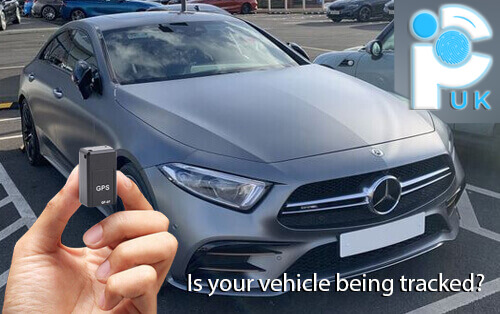
Suspect Your Car Is Bugged?
We provide professional vehicle debugging and bug sweep services across the UK. Our TSCM experts use advanced RF and GSM detection equipment to find and remove hidden GPS trackers or other surveillance devices. Learn more about our Bug Sweep services or contact us for a confidential, no-obligation quote.
Using Electronic Detection Tools
Sometimes, a careful physical inspection isn’t enough to locate a well-concealed tracker. In those cases, technology can assist you. Electronic detection tools range from smartphone apps to professional-grade RF sweepers. Here’s how they work:
- RF Detectors (Bug Sweepers): An RF detector is a handheld device that scans for radio frequency signals. Many GPS trackers communicate via GSM (the mobile phone network) or transmit RF bursts when sending data. A bug sweeper will alert (often with beeps or lights) when it detects an active transmission. To use one, you would slowly move it around and inside your car. If it starts indicating a strong signal in a particular spot, it could be picking up a tracker’s transmission. Keep in mind, you might also pick up signals from things like Bluetooth devices or even your phone, so it requires a bit of patience and interpretation. Our investigators use specialist RF spectrum analyzers and GSM signal detectors that can detect even faint "heartbeat" pings from covert devices.
- Electronic Frequency Scanning: Some advanced detectors can identify specific frequencies used by GPS trackers (for instance, common GSM bands or even satellite uplinks). There are also apps and hardware that can scan for unusual devices on Bluetooth or Wi-Fi frequencies (more on Bluetooth trackers in the next section). However, no single tool will catch everything. For example, if a tracker only transmits once every few hours to save battery, a quick scan might miss it. These are sometimes called dormant pings – the device lies dormant and “pings” its location intermittently. Professional debugging equipment can sometimes trigger a device to transmit or may catch even brief signals, but consumer devices have limitations.
- GPS Jammers (Not Recommended): A quick note on jamming: Some people wonder if they can use a GPS jammer to block any tracker. While devices that drown out GPS signals exist, they are illegal to use in the UK and can cause more problems (they might interfere with navigation systems or even aircraft signals!). Rather than trying to jam signals, it’s better to find and remove the offending tracker.
Tip: If you suspect a tracker but can’t find it, try taking your car to a quiet area away from other radio signals (like a rural location) and then use a detector. Also, consider that some trackers wake up when the car is moving – so scanning while a friend slowly drives the car (while you monitor the detector safely from the passenger seat) could help trigger a response. If all this sounds tricky, don’t worry - this is exactly the kind of task that professional Technical Surveillance Counter Measures teams handle, as we’ll discuss below.
Finding Apple AirTags and Other Smart Trackers
[insert AirTag image here]
Not all tracking devices use GPS and GSM. In recent years, Bluetooth-based trackers like Apple’s AirTag have entered the scene. An AirTag is a small, coin-sized device designed to help people locate lost items – but it has unfortunately been misused to track people’s vehicles without consent. Unlike a traditional GPS tracker that reports its location via mobile networks, an AirTag doesn’t have a built-in GPS or GSM modem. Instead, it uses Bluetooth signals to anonymously piggyback off of nearby smartphones (via Apple’s Find My network) to report its location. This means detecting an AirTag requires a different approach:
- If You Have an iPhone: Apple built in a safety feature – your iPhone will alert you if it detects an unknown AirTag moving with you. For example, if someone sneaks an AirTag into your car, after some time your iPhone should pop up a notification like “AirTag Detected Near You” (assuming the AirTag is separated from its owner). If you see this alert, you can tap it for options to make the AirTag play a sound to help locate it. Keep Bluetooth enabled on your iPhone so that you’ll receive these alerts.
- If You Have an Android Phone: Apple has an official app called Tracker Detect for Android, which you can download and run to scan for any AirTags (or other Find My-compatible trackers) nearby. It’s not automatic – you have to open the app and initiate a scan. There are also third-party Bluetooth scanner apps that can detect unknown Bluetooth devices around you, which might help find things like Tile trackers or Samsung SmartTags as well. Running a scan while in or near your car could reveal if there’s an active Bluetooth tracker present.
- Listening for Clues: AirTags will make a sound after they have been away from their owner for a certain period (generally around 8-24 hours). If an AirTag has been in your car for a day or more, you might eventually hear a faint chirping sound as it starts to emit periodic alerts. This isn’t loud – it sounds like a little set of chimes – but in a quiet car, you might catch it. Obviously, not a reliable method, but worth noting.
- Physical Inspection for AirTags: Because AirTags are quite small (about the size of a 10p coin, though thicker), they can be hidden in the cabin easily: taped under a seat, slipped into a seat cushion, inside the glove box or door pockets, etc. Do a sweep of your car’s interior for any object that looks like a white disc or any unfamiliar small gadget. AirTags have a white plastic face and a metallic back. They could be inside a case or holder, or just loose. Finding one visually can be challenging, but not impossible if you know what to look for.
Bluetooth trackers don’t show up on RF detectors the same way GSM-based trackers do (they use different frequencies and transmit intermittently). That’s why leveraging the phone apps is important for detection. If you do find an AirTag in your car that isn’t yours, you can disable it by removing the battery (twist the AirTag open). Additionally, you can lookup its serial number and report it to the police – law enforcement can potentially request information from Apple about the owner’s Apple ID, which might help identify who planted it.
When to Call the Professionals: Vehicle Bug Sweeps & TSCM
After you’ve done all the above, you might still have nagging doubts. Maybe you strongly suspect a tracker but just can’t find it, or you’ve found something and aren’t sure how to remove it safely. This is where a professional Technical Surveillance Counter Measures (TSCM) sweep comes in. Vehicle debugging is a specialised service – and it’s one we provide at Private Investigators UK.
Why get professional help? For one, experienced private investigators know exactly how and where to hide trackers. As mentioned, our team has planted and retrieved countless GPS trackers during legitimate investigations. We know all the sneaky hiding places, from the obvious to the truly obscure. A pro will methodically go through your vehicle, often dismantling certain sections if needed (with care, of course), to locate any clandestine device. We also use high-end detection equipment that far exceeds the capability of off-the-shelf bug finders. This includes spectrum analysers that can catch short bursts of signal, non-linear junction detectors (which can find electronic circuitry even if a device is not transmitting), and thermal cameras to spot the slight heat a powered device might emit.
What we offer: Our bug sweep service covers vehicles as well as homes and offices. If someone went to the trouble of tracking your car, it’s possible they’ve also bugged your home or phone – we’ve seen cases where multiple surveillance methods are used together. As part of a comprehensive TSCM sweep, we can check your car for GPS trackers, your home for hidden cameras or microphones, and even scan for spyware on phones (if needed or requested). All our work is done discreetly and confidentially. If we do find a device, we can remove it safely. In some cases, clients ask us to preserve the tracker so it can be turned over to police or used as evidence; other times, they just want it destroyed and their vehicle secured – we assist with either approach.
Peace of mind: Remember, you don’t have to live with the stress of wondering if you’re being watched. Professional investigators like us deal with these situations regularly. We can not only sweep and clear your car of any unwanted trackers, but also provide advice on how to prevent future incidents (for example, recommending better physical security for your vehicle, or periodic sweeps if you’re in a high-risk situation). We’re here to help make sure that your privacy is restored.
In summary, finding a GPS tracker on your car can be challenging – these devices are designed to stay hidden. By systematically checking the common hiding spots inside and out, using technology to aid your search, and calling in experts when needed, you can greatly improve your chances of uncovering a tracker. It’s important to stay vigilant: if someone has taken the step of tracking you, it’s a serious breach of your privacy and possibly a criminal act. Don’t hesitate to seek help. With the right approach and resources, you can root out these covert devices and take back control of your personal security.

You are reading the PrivateInvestigators-UK blog — home to the UK's leading detective agency. Learn more about us by visiting our homepage PrivateInvestigators-UK.com.